

History of Jyotisha
How Indian astronomy and astrology developed, from the Vedic calendar to the Kerala school and modern computation.
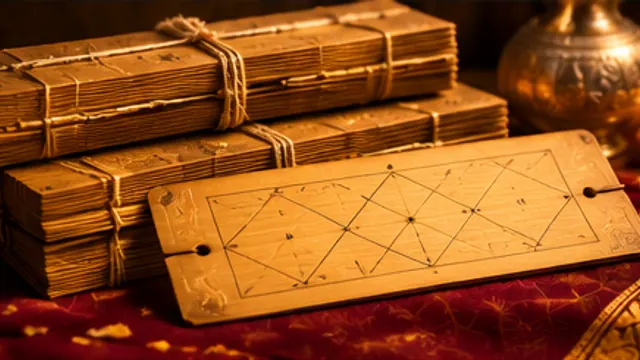
Jyotisha began as the Vedic science of time: a way of fixing the right day and hour for rituals by watching the Sun, the Moon and the stars. Over two thousand years it absorbed mathematical astronomy, Greek-influenced horoscopy and the detailed regional traditions of Kerala and Tamil Nadu, and it is now worked out on computers. Many early dates are uncertain, so where scholars disagree we say so.
Traditionally dated to c. 1400-1200 BCE; scholars debate, and some place the text in the last centuries BCE
Vedanga Jyotisha of Lagadha
The oldest surviving Indian text on time-reckoning, attributed by tradition to Lagadha, sets out a five-year lunisolar cycle (yuga) used to schedule Vedic rites. Its description of where the winter solstice fell has led some scholars to date it to around 1400-1200 BCE, while others, including Michael Witzel and David Pingree, argue that the observation may be older than the text that records it. It deals with calendar astronomy only and says nothing about horoscopes.
Traditionally dated to the 2nd-3rd century CE (149/150 and 269/270 CE, per Pingree); dating is debated
Yavanajataka: Greek horoscopy reaches India
The Yavanajataka ("horoscopy of the Greeks") is the earliest known Sanskrit work on horoscopic astrology, adapted from a Greek text of Hellenistic Alexandria. In David Pingree's account a prose translation by Yavaneshvara was later versified by Sphujidhvaja in western India, but more recent manuscript study by Bill Mak has questioned those dates and suggests a later range. Its Greek-derived terms, such as the drekkana (decan), show how horoscopy travelled between the two cultures.
499 CE
Aryabhata and the Aryabhatiya
Aryabhata wrote the Aryabhatiya, a compact verse treatise on mathematics and astronomy, stating that he was 23 years old when it was composed in 499 CE. It gave methods for planetary positions and eclipses and proposed that the Earth turns on its axis. Its parameters shaped later Indian astronomy, including the Kerala tradition.
6th century CE (Varahamihira c. 505-587 CE)
Varahamihira at Ujjain: Pancha Siddhantika, Brihat Samhita and Brihat Jataka
Working at Ujjain, Varahamihira summarised five earlier astronomical systems in the Pancha Siddhantika, two of which show Greek influence. His Brihat Samhita is an encyclopaedia of omens, weather, architecture and everyday knowledge, and his Brihat Jataka became one of the standard textbooks of natal astrology. Later writers quote him constantly, which makes him a bridge between early and medieval Jyotisha.
628 CE
Brahmagupta's Brahmasphutasiddhanta
Brahmagupta completed the Brahmasphutasiddhanta in 628 CE, a full astronomical system that also contains landmark mathematics, including rules for working with zero and negative numbers. It was later translated into Arabic and influenced astronomy in the Islamic world. Its methods for planetary positions remained a reference for Indian calendar makers for centuries.
Attributed to the sage Parashara; dating is debated (often placed c. 7th-8th century CE, with the extant text published only in the 20th century)
Brihat Parashara Hora Shastra
Tradition attributes this foundational text of natal astrology to the sage Parashara, and it is the main source for the Vimshottari dasha and many yogas used today. Scholars such as J. Gonda and David Pingree date its earliest parts to roughly the 7th-8th centuries CE, and the version now in print was assembled from manuscripts that resurfaced in the early 20th century. Its exact origin and how much it changed over time remain open questions.
Attributed to the sage Jaimini; dating is debated
Jaimini Sutras (Upadesha Sutras)
The Jaimini Sutras, also called the Upadesha Sutras, present a distinct method of chart reading built on sign-based aspects, chara karakas (significators chosen by planetary degree) and sign-based dashas such as chara dasha. Tradition credits them to the sage Jaimini, but no firm date for the text has been established. They are studied alongside the Parashari system rather than in place of it.
Traditionally dated to c. 800-1000 CE; dating is debated
Kalyana Varma's Saravali
Kalyana Varma compiled the Saravali, a large handbook of natal astrology that draws heavily on Varahamihira and earlier authors. Estimates of its date range from about 800 CE to the 10th century. It is still counted among the major classical texts of predictive astrology.
1150 CE
Bhaskara II's Siddhanta Shiromani
Bhaskara II, head of the astronomical tradition at Ujjain, completed the Siddhanta Shiromani in 1150 CE. Its sections on arithmetic (Lilavati), algebra, planetary mathematics and the celestial sphere became standard teaching texts across India. It is often treated as the high point of the classical siddhanta tradition.
Medieval, c. 13th-16th century CE (dating approximate and debated)
South Indian compendia: Phaladeepika and Jataka Parijata
Mantreswara's Phaladeepika, a concise Sanskrit manual in 28 chapters, became widely used in South India; scholars have not settled whether its author lived in the 13th or the 16th century. Vaidyanatha Dikshita's Jataka Parijata, another influential handbook, is usually placed in the 14th-15th centuries, with one reading of its colophon pointing to about 1426 CE. Both gather earlier rules into forms that practising astrologers still consult.
c. 1340-1501 CE (Madhava c. 1340-1425; Drigganita 1431; Tantrasangraha c. 1500-1501)
The Kerala school: Madhava, Parameshvara and Nilakantha
Madhava of Sangamagrama founded a remarkable line of Kerala astronomer-mathematicians and is credited with infinite series for sine, cosine and arctangent long before similar results in Europe. His student Parameshvara observed eclipses over several decades and, in the Drigganita of 1431, revised the older Parahita system of computation so that calculated positions matched what could be seen in the sky. Nilakantha Somayaji carried the line forward in the Tantrasangraha, completed around 1500-1501, and in related writings described a model in which the other planets circle the Sun while the Sun circles the Earth.
c. 1649 CE
Prashna Marga, the Kerala manual of horary astrology
The Prashna Marga, written in Kerala around 1649 CE and traditionally attributed to a Namboodiri astrologer of Edakkad near Thalassery, is the most detailed classical guide to prashna, answering questions from the moment they are asked. It brings together omens, natal techniques and procedures that underlie the ashtamangala prashna still practised in Kerala. Temple deva prashnams in the region continue to draw on its methods.
Medieval to present; observation-based (drik) almanacs gained ground from the 19th century
Regional panchangas: amanta, purnimanta, drik and vakya
Across India, local almanacs (panchangas, or panjikas in the east) list the five daily elements of tithi, vara, nakshatra, yoga and karana. Regions differ in whether a lunar month ends at new moon (amanta) or at full moon (purnimanta), and in Tamil Nadu almanacs follow either the traditional vakya method, based on memorised verse tables, or the drik (thiru-ganita) method, based on observed positions. When the older tables were seen to drift in the 19th century, reformers in Madras argued for drik almanacs, and both kinds are still published.
1952-1957 CE (committee formed 1952, report 1955, national calendar in use from 22 March 1957)
Indian Calendar Reform Committee and the Lahiri ayanamsa
In 1952 the Council of Scientific and Industrial Research set up a Calendar Reform Committee chaired by the physicist Meghnad Saha, with the astronomer N. C. Lahiri among its members, to study the roughly thirty calendars in use across India. Its 1955 report led to the Indian national calendar, officially in use from 22 March 1957, and to an official ephemeris and national almanac (Rashtriya Panchang), including a standard ayanamsa for religious calendars. That Chitrapaksha value, anchored to the star Chitra (Spica) and carried in the government's Indian Astronomical Ephemeris, is known as the Lahiri ayanamsa and is the most widely used sidereal reference in India today.
Late 20th century to present (Swiss Ephemeris first released 1997)
Computers, JPL ephemerides and the Swiss Ephemeris
From the late 20th century, astrologers moved from printed tables to software. NASA's Jet Propulsion Laboratory publishes high-precision planetary ephemerides (the DE series), and in 1997 Astrodienst released the Swiss Ephemeris, built on those data, which became a common engine for astrology programs. Today a chart that once took hours by hand can be calculated in moments, though the interpretive tradition still rests on the classical texts.
Astrology is offered as traditional guidance, not a guarantee or a substitute for professional advice. Read our disclaimer.

Timeless Jyotisha. Contemporary clarity.
Traditional Jyotisha, presented with precision, restraint and a modern sense of purpose.